
Written by Mortykay, a progression fantasy and Western Xianxia author. Creator of the completed 12-book saga Immortal Drunkard, and the ongoing dark cultivation series The Greatest Heretic.
If you’ve read Cradle, Mother of Learning, or Arcane Ascension, you already know the appeal of progression fantasy: start weak, learn, train, break through—and eventually become powerful enough to face enemies who once seemed untouchable.
That progression is not just something that happens along the way. It is part of the reason you keep reading.
Most fantasy contains some form of growth. Harry Potter learns increasingly advanced magic. Rand al’Thor becomes vastly more powerful throughout The Wheel of Time. But progression fantasy puts that growth at the center of the experience. The reader understands that greater levels of power, mastery, or capability exist—and expects the protagonist to reach them.
The term itself is surprisingly young. “Progression fantasy” was coined in 2019, following discussions between Arcane Ascension author Andrew Rowe and Cradle author Will Wight, with the final name suggested by Jess Richards. It gave a name to stories that had already existed across cultivation novels, LitRPG, fantasy web serials, and other traditions, but didn’t fit neatly into any one of them.
So the simplest definition might also be the best: Most fantasy contains progression. Progression fantasy makes progression part of the promise.
But that still leaves an important question: where exactly is the line?
What Makes Progression Fantasy Different from Regular Fantasy?
The difference is not whether the protagonist becomes stronger. It is whether becoming stronger is one of the story’s central goals.
Take The Lord of the Rings. Aragorn fights, travels, gains authority, and eventually becomes king—but readers are not waiting for him to unlock a stronger sword technique or reach the next stage of combat mastery. His growth matters, but it isn’t structured as progression.
Cradle works differently. Lindon begins at the bottom of a clearly established hierarchy of power. Advancing through the Sacred Arts gives him access to new abilities, allows him to challenge stronger opponents, and opens the path toward still higher stages. Each advancement matters because the reader already knows there is another mountain above it.
This creates a characteristic loop:
challenge → training → advancement → new capabilities → greater challenge
Not every progression fantasy follows that pattern literally. Mother of Learning builds progression through accumulated magical knowledge and practice, while Arcane Ascension combines magical education, attunements, and measurable increases in magical capability.
That also explains why a detailed magic system alone does not make a book progression fantasy. Brandon Sanderson’s Mistborn, for example, has clearly defined magical rules and characters who learn to use them more effectively. But mastering progressively higher stages of Allomancy is not the structural engine of the series.
In progression fantasy, power growth is more than character development. It creates goals, expectations, and payoffs of its own.
The Progression Ladder: Vertical vs. Horizontal Progression
Progression fantasy needs somewhere to progress.
Sometimes that path is obvious. Iron Prince assigns combatants ranks from E through S. LitRPG can make the ladder even more explicit with levels, attributes, skill ranks, and experience points.
But a progression ladder doesn’t have to be literal. The protagonist simply has to become meaningfully more capable in a way the reader can recognize.
Most progression can be divided into two directions:
Vertical Progression — Moving Up
Vertical progression increases the character’s existing power. The numbers get bigger, the ranks get higher, and previously dangerous opponents become manageable.
Typical examples include:
- Higher ranks: Iron → Bronze → Silver → Gold
- More resources: larger mana, qi, or stamina reserves
- Better attributes: strength, speed, durability, intelligence
- Stronger abilities: a fireball becomes hotter, larger, or cheaper to cast
- Higher stages: advancing to the next cultivation realm or magical circle
Solo Leveling embraces this almost literally. Sung Jinwoo begins as the notoriously weak E-Rank Hunter and rapidly accumulates levels, attributes, abilities, and eventually overwhelming power.
The appeal is simple: vertical progression makes growth immediately visible.
Horizontal Progression — Expanding Outward
Horizontal progression increases the character’s options rather than simply their raw power.
This can mean:
- New techniques without necessarily making existing ones stronger
- New magical disciplines or affinities
- Better control over existing abilities
- Counters and specialized tools for particular enemies
- Crafting, alchemy, enchanting, or other secondary skills
- New combinations between previously acquired abilities
Zorian in Mother of Learning is a good example. Much of his growth comes not from acquiring a higher universal rank, but from building an increasingly broad toolkit: mind magic, spell formula expertise, golem creation, combat magic, and knowledge accumulated across repeated loops.
Most Progression Fantasy Uses Both
Pure vertical growth is easy to understand, but taken too far it can become little more than bigger numbers and bigger explosions. Horizontal progression gives those increases somewhere interesting to go.
A protagonist who is ten times stronger is impressive.
A protagonist who has learned ten new ways to solve a problem is harder to predict.
The best progression ladders therefore answer two questions at once:
- How powerful is the protagonist now?
- What can they do now that they couldn’t do before?
Common Progression Systems
Not every progression fantasy measures growth the same way. Some tell you exactly where a character stands: Level 47, Gold Rank, Third Circle. Others show progression through new skills and accomplishments without assigning a number to anything.
Broadly, progression systems exist on a spectrum:
- Hard progression: levels, stats, ranks, or other clearly defined thresholds.
- Structured progression: distinct stages exist, but characters at the same stage can still differ considerably.
- Soft progression: growth is demonstrated primarily through skills, knowledge, and changing capabilities.
These categories describe how visible and measurable progression is. The systems below show some of the most common ways fantasy actually structures that growth—and they frequently overlap.
Cultivation Progression
Cultivation treats advancement as the transformation and refinement of the practitioner.
Characters accumulate qi, essence, or another form of spiritual energy; strengthen their bodies and souls; master techniques; and break through into higher realms.
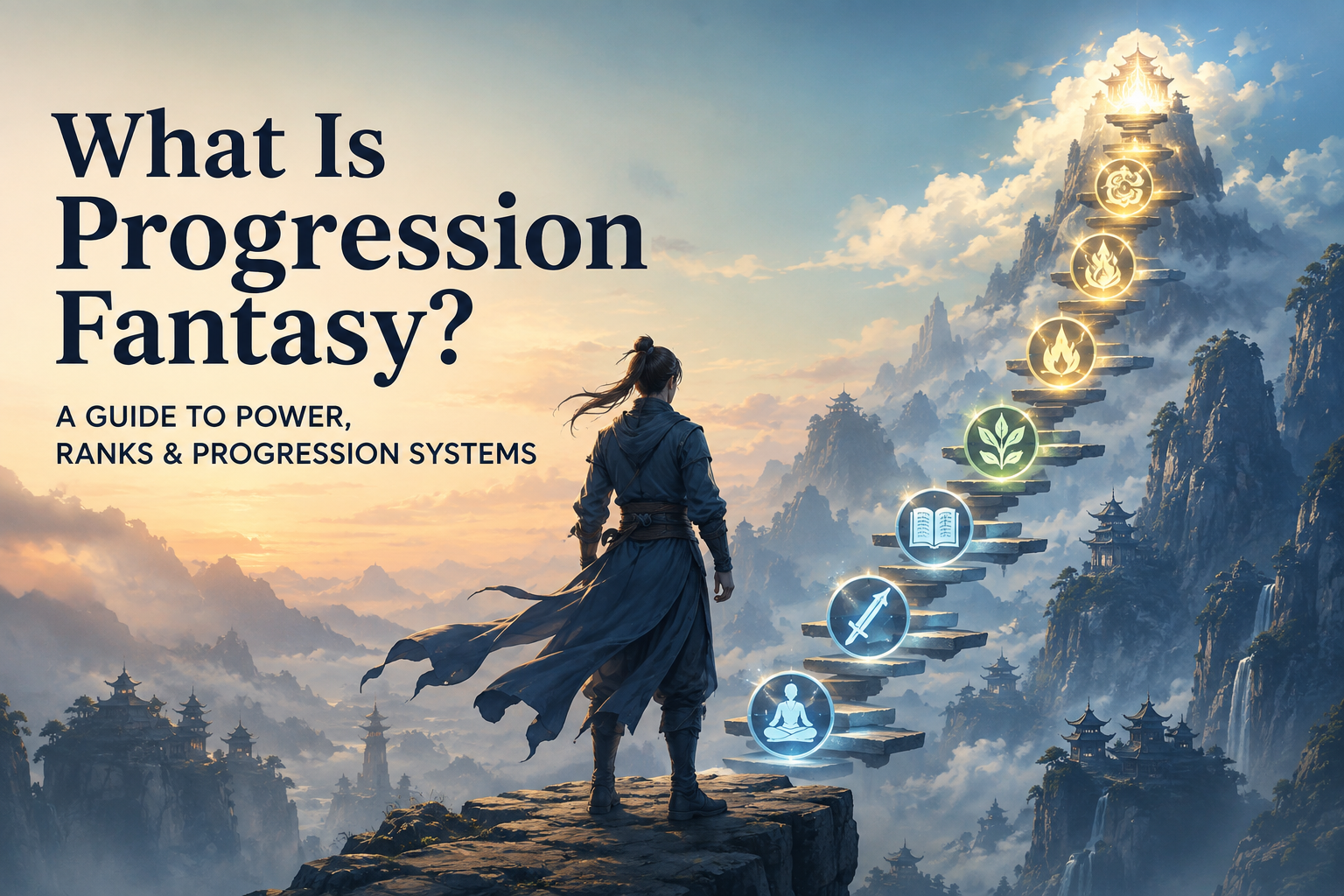
A typical ladder might look like: Qi Gathering → Foundation Establishment → Core Formation → Nascent Soul
A Record of a Mortal’s Journey to Immortality makes these realms fundamental to both its world and story. Cradle adapts the same principle through stages such as Copper, Iron, Jade, Gold, and Underlord.
Cultivation is usually structured rather than strictly numerical. Two cultivators in the same realm may differ enormously in techniques, foundations, equipment, and experience.
More importantly, advancement often transforms the practitioner themselves—their body, lifespan, perception, or spiritual capabilities. It isn’t simply leveling with qi instead of XP.
Level-Based Progression
This is progression in its most measurable form: Level 1 → Level 10 → Level 50
Characters gain experience, attributes, skills, classes, and other numerical improvements. Unsurprisingly, this is closely associated with LitRPG.
Dungeon Crawler Carl uses levels, stats, skills, classes, achievements, and equipment to make progression directly visible.
This clarity comes with a cost. If Strength 100 is supposed to be far beyond Strength 20, the story eventually has to demonstrate what that difference means. Otherwise, the numbers become decoration.
Rank-Based Progression
Ranks replace precise numbers with broader categories:
F → E → D → C → B → A → S
or:
Iron → Bronze → Silver → Gold
Iron Prince makes ranked advancement an explicit part of its combat system, allowing the reader to immediately understand how far its characters have climbed.
But ranks don’t always represent absolute power. They may describe stages of advancement, institutional classifications, or simply approximations. A C-Rank fighter with an unusual ability might still defeat someone officially ranked above them.
That ambiguity gives authors a clear hierarchy without making every fight mathematically predetermined.
Magic-Based Progression
Sometimes magic itself becomes the ladder.
A mage might advance through magical circles, increase their mana capacity, gain affinities, master more complex spells, or deepen their understanding of the underlying system.
But a hard magic system is not automatically a progression system.
Mistborn has detailed rules governing Allomancy, yet the series is not structured around Vin steadily climbing through increasingly powerful stages of Allomancy.
Arcane Ascension, by contrast, makes magical development a recurring objective. Attunements grow, mana capacities matter, and greater mastery produces capabilities that were previously inaccessible.
The distinction is structural: learning magic has to drive progression, not merely accompany the plot.
Skill-Based Progression
Progression doesn’t require a universal power ladder at all.
Swordsmanship, crafting, alchemy, enchanting, strategy, or virtually any other skill can provide meaningful advancement.
Mother of Learning frequently works this way. Zorian becomes more capable by accumulating knowledge and developing an increasingly broad magical toolkit rather than climbing a universal sequence of character levels.
The progression is visible through results: couldn’t do it → learned how → can do it → learns something harder
This is where softer progression systems often thrive.
Progression Fantasy Doesn’t Need Numbers
The heavy overlap between progression fantasy and LitRPG sometimes makes the two look interchangeable. They aren’t.
Levels, XP, attributes, and character sheets are ways to measure progression—not requirements for creating it.
A story can make advancement perfectly clear without attaching a numerical value to every improvement. In fact, softer systems often place more responsibility on the writing: a LitRPG can tell us that Strength increased from 20 to 35; a softer system has to show what that improvement changed.
Numbers measure progression. They do not create it.
The Problem of Progression Fantasy
Progression fantasy has a problem built into its greatest strength: the protagonist has to keep progressing.
Once readers become invested in advancement, standing still for too long can feel like the story itself has stopped. The next rank has to come. Then another. The enemies have to become stronger to remain threatening, which means the protagonist has to become stronger again.
That is how a story can begin with a desperate fight against a single monster and end several books later with characters destroying mountains.
This is power creep, and progression fantasy is particularly vulnerable to it.
Cultivation novels are famous for taking the idea to extremes. A protagonist may begin as an insignificant mortal, surpass the strongest cultivators in his homeland, discover that his entire world is merely one corner of a greater realm—and immediately find himself near the bottom again.
LitRPG has its own version: Level 10 → Level 100 → Level 1,000 → Level 10,000
The numbers increase, but unless something meaningful changes with them, progression can become strangely static. Killing a monster with 10,000 HP using an attack that deals 1,000 damage is not fundamentally different from killing one with 100 HP using an attack that deals 10.
The same problem affects antagonists. If every defeated enemy is immediately replaced by someone stronger, villains can start feeling less like characters and more like increasingly large numbers attached to health bars.
Good progression fantasy avoids this by expanding progression sideways as well as upward:
- introducing new abilities rather than simply stronger versions of old ones;
- forcing characters to specialize and make trade-offs;
- creating opponents that require counters, knowledge, or preparation;
- making control and efficiency matter alongside raw power;
- introducing problems that cannot be solved simply by reaching the next rank.
The Weirkey Chronicles offers an interesting example. Its soulhome-based magic gives characters room to improve not only by becoming stronger, but by changing the structure, composition, and interactions of the powers they build. Advancement can alter the character’s toolkit rather than simply multiplying their existing output.
Because ultimately, bigger is not the same as better.
A good progression system doesn’t merely make yesterday’s numbers obsolete. It changes the kinds of problems a character is capable of solving—and gives them new problems worth solving.
So, What Counts as Progression Fantasy?
Progression fantasy doesn’t need levels, stats, cultivation realms, or conveniently color-coded ranks. Those are tools—not the genre itself.
What matters is whether becoming more capable is one of the story’s central promises. The reader should be able to recognize meaningful growth, understand why it matters, and anticipate where it might lead next.
That growth can mean reaching Gold Rank, breaking through to a new cultivation realm, mastering a branch of magic, or finally learning a sword technique that seemed impossible a hundred pages earlier.
The method changes. The appeal doesn’t.
You start by asking: “What happens next?”
And somewhere along the way, another question becomes just as important: “What will they be capable of when it does?”
Progression Fantasy FAQ
No. LitRPG uses explicit game mechanics such as levels, stats, classes, and experience points. Progression fantasy only requires meaningful advancement, so books like Cradle and Mother of Learning qualify without RPG mechanics.
No. Isekai describes being transported or reincarnated into another world. Many isekai stories contain progression systems, but the concepts are independent.
No. Power fantasy emphasizes the experience of being powerful; progression fantasy emphasizes becoming powerful. A story can easily be both.
No. Levels are simply one way to make advancement visible. Ranks, cultivation realms, magical mastery, skills, or demonstrated improvement can serve the same purpose.
No. Those features are primarily associated with LitRPG. Progression fantasy can contain no numerical statistics whatsoever.
No. Academy fantasy describes a setting or story framework. It frequently overlaps with progression fantasy because schools naturally provide training, examinations, ranks, and increasing mastery.
No. Crafting, alchemy, magical research, leadership, or other forms of mastery can drive progression without making combat the primary focus.
The term was introduced in 2019 following discussions between authors Andrew Rowe and Will Wight, with the name itself suggested by Jess Richards.
The name is new; the underlying storytelling traditions are not. Modern progression fantasy draws heavily from cultivation fiction, LitRPG, RPGs, web novels, martial arts stories, and older training-focused fantasy.
Fantasy in which becoming more powerful, skilled, or capable is a major part of the story’s appeal. Most fantasy contains progression. Progression fantasy makes progression part of the promise.